Article Summary 2025-11-08
Article title
Lysine-specific histone demethylase complex restricts Epstein–Barr virus lytic reactivation
Journal
Nature Microbiology
Tags
Reverse genetics; Histone demethylase
Introduction
Epstein-Barr virus (EBV) can infect 95% people and cause cancers such as gastric carcinoma. EBV shows latency in cells and activated to lyse the cell to proliferate. The latency of EBV caused inefficiency of EBV-target antivirus drugs. However, the factor that regulates the EBV conversion from latency to activated remain unknown.
This work
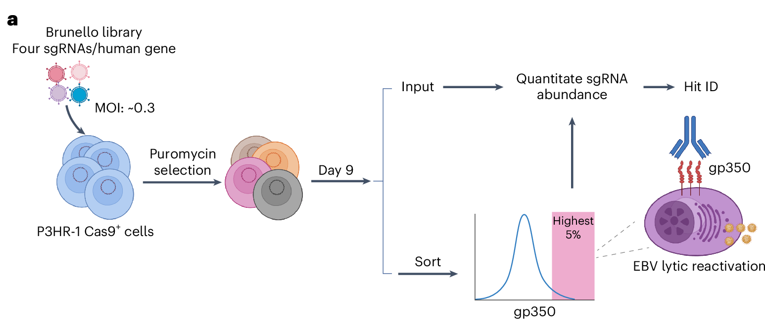
Here this work leverages CRISPR screening to discover LSD1/ZNF217/CoREST complex as a regulator of EBV lytic reactivation. CRISPR was used to probe mutant cells with high p350 expression (EBV reactivation phenotype). Then they validated that LSD1/ZNF217/CoREST restricted the lytic reactivation of EBV. Thus through combination of LSD1/HDAC bi-inhibitor and anti-virus drug, EBV could be effectively killed in cells to enhance the mouse xenograft viability. Next, this work found ZNF217 recruited LSD1 and CoREST to chromatin to decrease genome H3K4 methylation and alter the chromatin organization validated by 3C experiments. In addition, knockout of KDM2D, also helped reactivation of EBV, indicating the role of H3K4 methylation in EBV reactivation.
doi
10.1038/s41564-025-02165-7